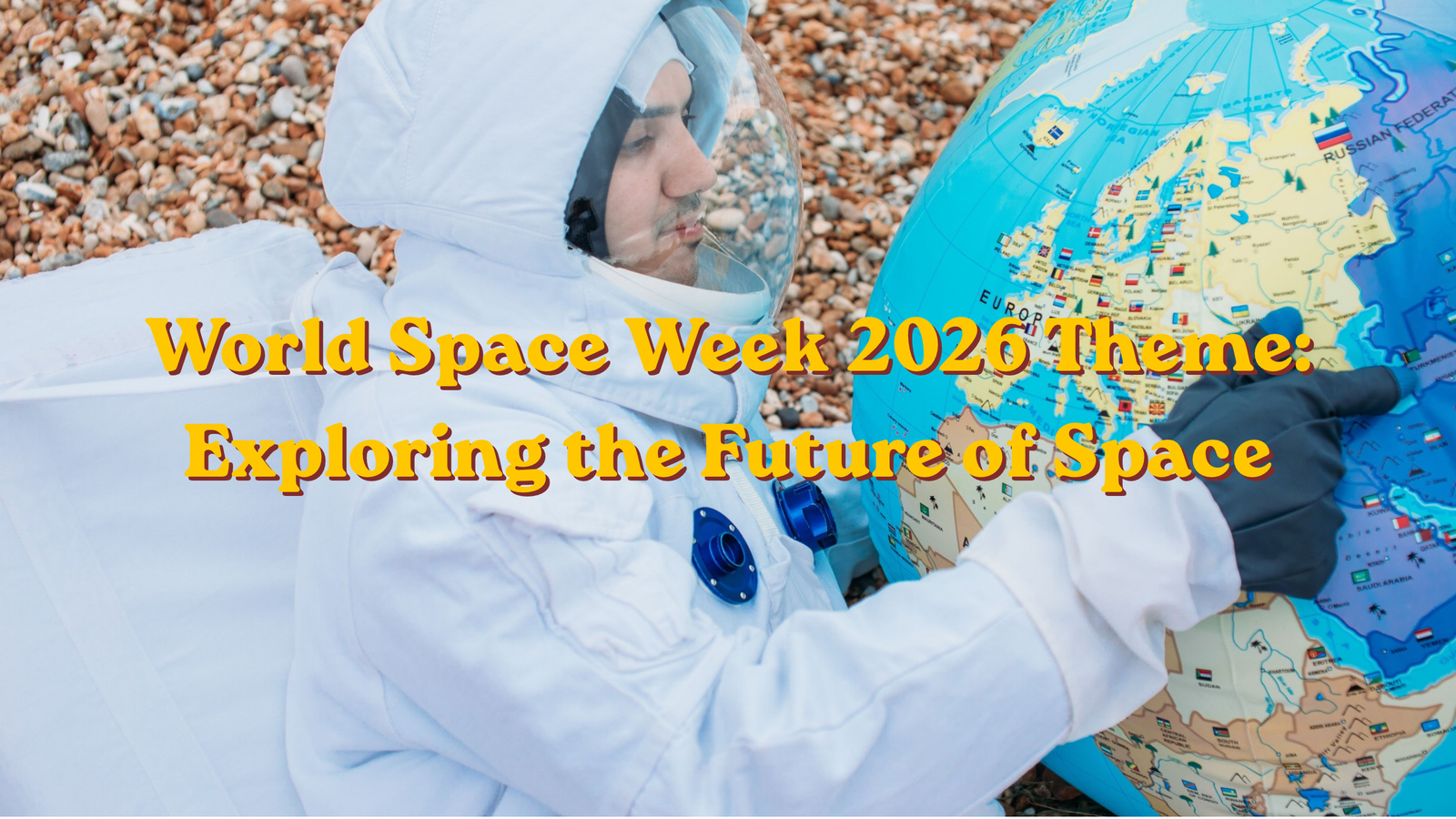
World Space Week is an annual global celebration held from October 4 to 10, bringing attention to the ways space science and technology influence life on Earth. The dates connect two milestones in space history: the launch of Sputnik 1, the first human-made satellite, on October 4, 1957, and the signing of the Outer Space Treaty on October 10, 1967. Together, these events represent both the beginning of the space age and the international effort to establish principles for responsible activity beyond Earth.
In 2026, the focus turns toward possibility with the theme “Exploring the Future of Space.” The world space week 2026 theme invites people to look beyond historic achievements and consider what the next era of exploration could bring. It encourages imagination, but it also prompts serious examination of the responsibilities associated with expanding space activity. Future missions and technologies will raise scientific, ethical, environmental, and social questions, including how space resources should be used, how orbital environments can be protected, and how the benefits of innovation can be shared fairly.
The observance provides an opportunity for students, educators, scientists, engineers, policymakers, industry professionals, and the wider public to participate in a common conversation. Educational programs, exhibitions, public talks, demonstrations, classroom activities, and community events can make complex subjects accessible while encouraging curiosity and informed discussion. These activities may help young people understand potential careers in science, technology, engineering, and mathematics, while showing communities how space capabilities support everyday needs.
Exploring the future of space is not limited to journeys toward distant planets or the development of advanced spacecraft. It also includes stronger Earth-observation systems, more reliable communications, improved navigation, climate monitoring, scientific research, disaster response, and cooperation among nations. The world space week 2026 theme therefore presents the future as both an ambitious frontier and a shared responsibility. By connecting discovery with stewardship and inclusion, World Space Week can help audiences consider how space activity should develop and whom it should serve.
Reusable launch systems are likely to define the economics of the next space era. By recovering and flying major vehicle components repeatedly, providers can reduce manufacturing costs, increase launch frequency, and make scientific, commercial, and exploration missions more accessible. More dependable launch infrastructure could support large observatories, cargo delivery, and sustained lunar operations. However, reuse must be assessed through the full life cycle of vehicles, including refurbishment requirements, safety standards, fuel consumption, and the reliability needed for increasingly complex missions.
Robotic spacecraft will extend exploration into places where human crews cannot yet travel safely or affordably. Autonomous navigation, artificial intelligence, and advanced instruments can help vehicles identify targets, adjust routes, interpret data, and operate with limited communication from Earth. Such systems may investigate the surfaces of icy moons, enter hostile atmospheres, or study distant asteroids. Improvements in sensors and onboard computing will allow spacecraft to respond more effectively to changing conditions while reducing delays caused by communication across great distances.
The Moon is emerging as an important testing ground for this progress. New landing systems, autonomous surface vehicles, resource surveys, and lunar communications networks could support repeated scientific expeditions and eventual commercial activity. Research into water ice, minerals, and construction materials may help establish useful infrastructure, although responsible development will require clear rules for environmental protection, access, and international cooperation. These advances are central to discussions surrounding the world space week 2026 theme and its focus on future possibilities.
Farther from Earth, improved propulsion, lightweight materials, nuclear power concepts, and more capable life-support systems may enable longer missions across the solar system. At the same time, satellite constellations and Earth-observation instruments are becoming essential to navigation, climate monitoring, communications, agriculture, and emergency response. Their benefits must be balanced with cybersecurity, affordability, responsible design, collision avoidance, and orbital sustainability. Technological progress will be meaningful only if it remains reliable and limits the long-term consequences of placing more hardware around Earth.
Future space exploration will be measured not only by distance traveled, but also by the knowledge gained and the choices made along the way. Missions to the Moon, Mars, asteroids, and the outer solar system can reveal how planets form, how geological systems evolve, and whether the ingredients for life exist elsewhere. Samples from asteroids may clarify the origins of water and organic compounds, while studies of icy moons could offer important evidence in the search for environments capable of supporting life. These investigations give the world space week 2026 theme a human dimension: curiosity becomes a shared effort to understand Earth’s place in the universe.
Human activity beyond Earth presents equally complex challenges. Long-duration missions will expose crews to radiation, isolation, disrupted sleep, psychological stress, limited supplies, and delayed medical support. Reliable closed-loop systems must recycle air and water, manage waste, and produce or preserve food with minimal resupply. A short expedition, a temporary research outpost, and a permanent settlement are fundamentally different undertakings. Moving from one stage to another will require evidence-based planning, adaptable infrastructure, and realistic assessments of human health rather than simple confidence that technology will solve every problem.
International cooperation should guide this expansion. Partnerships can distribute costs, combine scientific expertise, and help ensure that discoveries and practical benefits are not restricted to a small group of nations or private organizations. Space activities should remain peaceful, protect celestial environments, and treat extraterrestrial resources as a matter requiring transparent rules and responsible stewardship.
Sustainability also begins near Earth. Orbital debris threatens satellites and crewed spacecraft, while light pollution and radio interference can limit astronomical research. Planetary protection measures are needed to prevent biological contamination in both directions. Governance frameworks should address these risks, establish accountability for resource use, and preserve access for future generations. Exploration will be most durable when innovation is matched by environmental care, ethical judgment, and an inclusive vision of humanity’s shared future.
World Space Week 2026 can become a practical learning opportunity when its theme is connected to questions that matter in daily life. Educators might ask students to design a future lunar habitat, balancing shelter, energy, food production, recycling, and psychological well-being. Other activities could compare robotic and human missions, analyze satellite images, build simple spacecraft models, or use diagrams to investigate orbital mechanics. A structured debate on the ethics of space settlement can encourage learners to consider ownership, environmental responsibility, cultural perspectives, and the rights of future generations.
Families and community groups can extend the experience beyond the classroom. Public programs might include expert panels, science demonstrations, documentary screenings, astronomy nights, museum workshops, essay contests, and collaborative art projects. Effective events should connect imagination with evidence-based science, giving participants opportunities to distinguish established knowledge from speculation while still considering ambitious possibilities. A local astronomy evening, for example, can combine telescope observations with explanations of planetary motion, light pollution, and the tools scientists use to study distant worlds.
The world space week 2026 theme also provides a useful framework for examining how space technology supports life on Earth. Participants can investigate the role of satellites in weather forecasting, disaster response, agriculture, navigation, environmental monitoring, and global communications. Research projects might map changes in forests or coastlines, evaluate storm-tracking data, or explore how remote sensing helps communities prepare for hazards. These examples show that space exploration is not separate from terrestrial needs; it is part of a wider technological and environmental system.
Students can also discover that space careers extend well beyond astronautics. Astronomy, engineering, computer science, medicine, environmental science, law, education, design, and public policy all contribute to responsible exploration. By asking what kind of future humanity should build in space, who should benefit, and how exploration can advance knowledge while protecting Earth and the space environment, participants can approach the subject with curiosity and judgment. The future will be shaped not only by machines and missions, but by imagination, cooperation, and informed public participation.