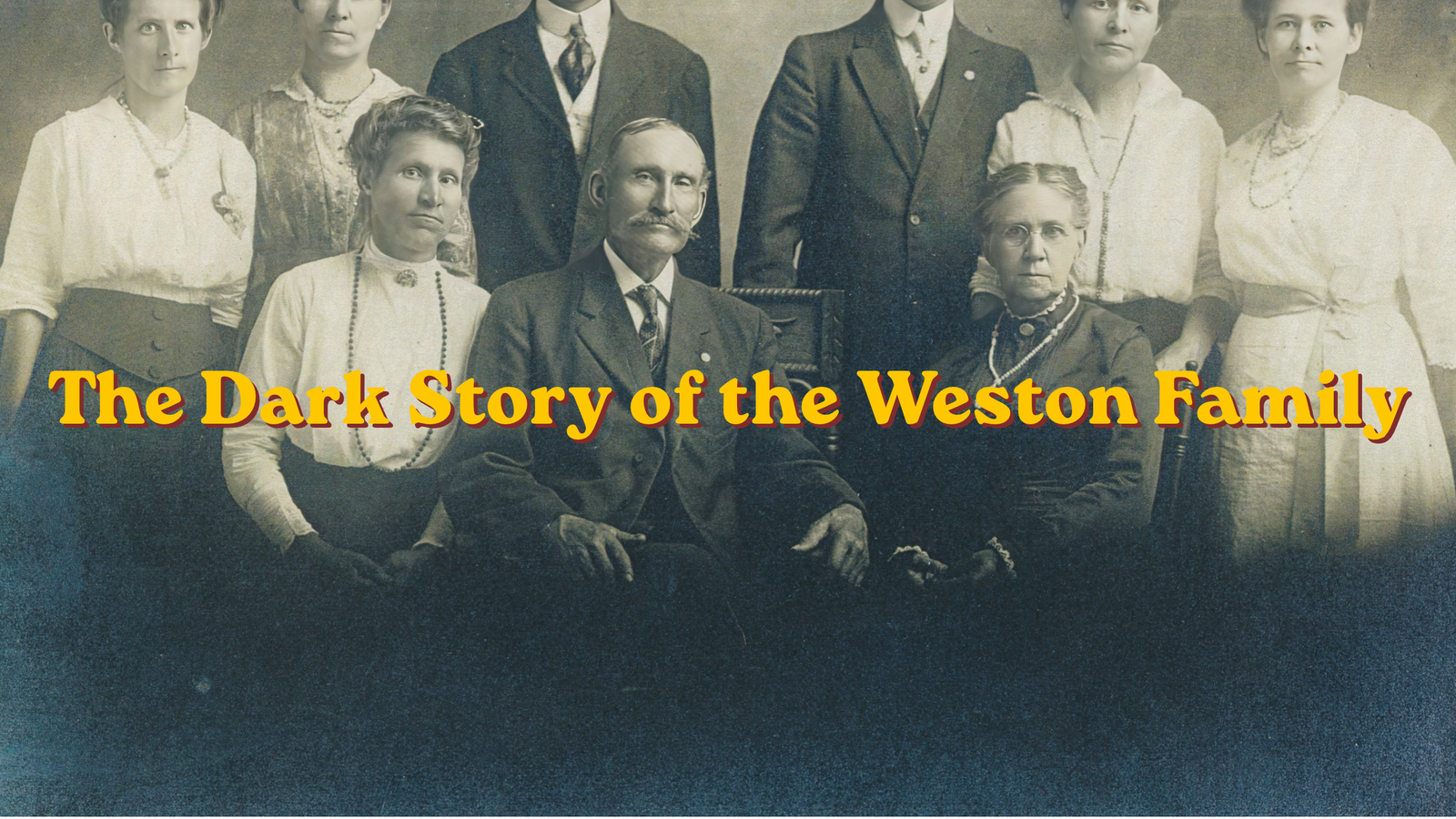
Some family names carry a history that can be traced through records, photographs, and carefully preserved recollections. Others seem to gather meaning in the spaces between what was written down and what was deliberately left unsaid. The Weston family belongs to the latter category. Across generations, its story has been shaped by guarded conversations, incomplete accounts, and incidents remembered differently by those who witnessed them—or claimed to have done so.
From the beginning, the family’s history appears less like a single, orderly narrative than a collection of fragments. Official documents offer one version of events, while private letters, local reports, and later testimony suggest another. Certain names recur in connection with misfortune, disputes, and sudden departures, yet the details surrounding those episodes remain uncertain. In some accounts, the Westons were victims of circumstances beyond their control. In others, they were portrayed as having concealed damaging truths behind respectability and silence.
That uncertainty is central to the enduring fascination with the Weston family. Rumors persisted because they were never fully answered, but rumors alone cannot establish what happened. Missing records may reflect deliberate concealment, ordinary loss, or the distortions that occur when stories pass from one generation to the next. Even accusations repeated for decades can change shape, acquiring dramatic details that were absent from the earliest accounts.
The questions, therefore, are as important as the allegations. Where did the family’s troubles truly begin? Why did the Weston name become associated with tragedy? Who benefited when relatives, neighbors, or authorities chose not to speak? And were the darkest elements of the story grounded in fact, or did fear and repetition transform ordinary wrongdoing into something more sinister? Answering those questions requires separating evidence from interpretation without dismissing either too quickly. What follows is not a simple tale of guilt or innocence, but an examination of how secrecy can preserve a family’s power, deepen its wounds, and allow its most troubling stories to endure.
The earliest picture of the Weston family is necessarily more complicated than later accounts suggest. The name appears in records associated with several communities, and without a confirmed place, date, or line of descent, it is important not to merge unrelated households. Parish registers, census returns, land deeds, newspaper notices, and probate files can establish where a particular branch lived, how large it was, and whether its members worked as farmers, tradespeople, laborers, professionals, or business owners.
These sources also help define the family’s social setting. A household that attended the same church, traded with nearby merchants, served on local committees, or employed neighbors may initially have been regarded as established and respectable. Conversely, repeated moves, financial disputes, estrangement, or dependence on charitable institutions might indicate instability, even when public descriptions remained polite. Relationships with neighboring families are especially revealing because marriages, witnesses on legal documents, shared businesses, and school connections often show a degree of trust that formal biographies omit.
Family tradition can add texture, but it should not be treated as proof. Stories of an ancestor who was unusually ambitious, secretive, wealthy, or feared may preserve a genuine memory, yet they can also be altered by retelling. Dates, motives, and identities should therefore be tested against contemporary documentation. A later accusation should likewise not be projected backward as evidence that the household was always divided or troubled.
Establishing this baseline matters because reputations are shaped by contrast. If the Westons were publicly viewed as respectable, their later notoriety may have seemed particularly shocking; if they were already isolated or controversial, subsequent stories may have amplified existing suspicions. The most responsible account separates verifiable facts from inherited anecdotes and recognizes uncertainty where records are incomplete. That approach does not weaken the history. It clarifies which elements belong to the documented past and which belong to the enduring mythology surrounding the Weston family.
At the center of the Weston family narrative stands a house whose significance extends beyond its walls. Set apart from the main road, the property is often imagined as a place of distance: bordered by overgrown vegetation, weathered fencing, and a landscape that seems to absorb sound. Its isolation may have been practical rather than deliberate, reflecting older patterns of rural construction, yet the separation encouraged neighbors to view the home as private and unknowable. A building seen only from a distance can quickly become a screen onto which a community projects its concerns.
The house’s architecture further supports its unsettling reputation. Tall windows, narrow corridors, unfinished upper rooms, and doors that remained locked would have created ordinary inconveniences, but later accounts treated them as evidence of concealment. Changes made over time may have added to the confusion. Renovations can close passages, divide large rooms, or cover original features, leaving later visitors uncertain about the building’s first design. Areas damaged by neglect, water, or age may also have appeared deliberately altered. In such surroundings, a missing staircase or sealed doorway becomes a story before it becomes an architectural question.
Ownership and occupancy shaped the property’s public image as well. A house that passed between relatives, stood vacant, or was maintained unevenly would have attracted attention without offering clear explanations. Children, passersby, and nearby residents could notice lights, sounds, or movement, while the family’s silence allowed speculation to continue. Local storytelling then preserved details that formal records might overlook, repeating claims of abandoned rooms, nighttime activity, or objects left behind.
Reports of cold spaces, footsteps, or apparitions belong to the realm of belief and testimony, not established fact. Drafts, settling timber, animals in wall cavities, faulty wiring, and unfamiliar acoustics can provide plausible explanations for many experiences. Even so, practical causes do not erase the house’s cultural power. For the Weston family, the property became a vessel for memory, secrecy, and rumor, its neglected appearance making every unanswered question seem physically present.
The earliest surviving references to the Weston family describe an unremarkable household, established through steady work, marriage connections, and modest property holdings. That image changed after one member disappeared without a clear explanation. Parish entries and a later estate document confirm the person’s absence, but neither identifies foul play. A brief notice in a local paper mentions a departure, while relatives later claimed that the individual had been forced away after a private dispute. The conflicting accounts marked the first point at which the family’s name became associated with secrecy.
A second disruption followed when a death occurred within the household under circumstances that remained poorly documented. The official record gives a cause but offers little context, and no inquest survives in the accessible archive. Decades afterward, former neighbors described an argument shortly before the death, although their recollections differ concerning who was present. Because those statements were recorded retrospectively, they cannot establish what happened. Nevertheless, repeated references to the incident changed public perceptions, turning ordinary grief into suspicion.
Financial trouble then exposed tensions that had previously remained private. Property was transferred, debts were called in, and an inheritance passed to a relative outside the immediate household. Legal papers support the existence of these transactions, but they do not explain whether they resulted from coercion, poor judgment, or a deliberate attempt to protect assets. The abrupt changes encouraged estrangement among family members and gave rise to rumors that the Weston family was concealing money as well as personal disagreements.
By the time a later domestic quarrel was mentioned in witness testimony, the pattern already seemed established: disappearance, unexplained loss, and contested inheritance. The surviving records prove disruption, not criminality. More dramatic details—threats, secret agreements, and deliberate silence—appear mainly in memoirs and oral histories written long afterward. Their persistence reveals how the family’s reputation formed, even where the evidence remains incomplete.
Within the weston family, private relationships may have shaped events as strongly as public decisions. Rivalries between relatives could emerge from unequal authority, differing expectations, or long-standing resentments rather than a single dramatic dispute. A marriage kept outside official records, a contested claim of parentage, or an heir whose place was questioned could alter the balance of trust within the household. Such matters are difficult to interpret when surviving accounts were written by people with reasons to defend their own conduct.
Inheritance was another source of tension. Property, business interests, and social standing often depended on documents controlled by a small number of relatives. Those who managed wills, correspondence, or household finances could decide which version of events reached the wider community. Individuals excluded from family histories may have been estranged, disinherited, illegitimate in the language of the period, or simply inconvenient to those preserving a respectable image. Their absence should not automatically be treated as proof of wrongdoing, but it does reveal how family narratives were constructed.
Allegations of abuse and betrayal require particular care. Records may preserve accusations without establishing what happened, while silence may reflect fear, loyalty, shame, dependence, or an effort to protect children and vulnerable relatives. A person who remained quiet was not necessarily complicit, just as a relative who spoke publicly was not necessarily fully informed. The emotional pressures of kinship could make resistance costly, especially when housing, money, employment, or social acceptance depended on cooperation.
Power inside the household was therefore unlikely to be distributed evenly. The person controlling finances, correspondence, travel, or access to respected outsiders could also control information. Other relatives may have adapted by withholding knowledge, changing their names, leaving the household, or preserving private memories that never entered the official record. Viewing the weston family through these human conflicts does not settle every disputed account. It does, however, show how secrecy can grow through ordinary acts of protection and self-preservation, until silence itself becomes part of the legacy.
The turning point in the Weston family’s history came with an incident remembered less for a single confirmed fact than for the contradictions surrounding it. On a winter night, according to later accounts, a disturbance was reported at the family residence after neighbors heard shouting and a sharp report from inside the house. When authorities arrived, one family member was dead, another was missing, and the remaining occupants offered accounts that did not entirely agree. Early newspaper reports described the event as a possible accident, while relatives privately suggested that fear, coercion, or deliberate violence had been involved.
Investigators documented the scene, removed firearms and personal papers, and recorded footprints, damaged furniture, and blood evidence whose interpretation remained disputed. The official inquiry reportedly found no conclusive proof of an intruder, yet the absence of forced entry did not settle the matter. Supporters of the accident theory pointed to poor lighting, unreliable weapons, and confusion during the emergency. Others argued that missing correspondence and a hurriedly cleaned room indicated a cover-up. Stories of voices heard after the death introduced a supernatural explanation, although skeptics attributed them to grief, rumor, and the house’s acoustics. None of these interpretations can be treated as established without reliable records.
The immediate consequences were nevertheless unmistakable. The investigation divided surviving relatives, who disagreed over whether to cooperate publicly or protect the family’s reputation. One account places an arrest in the weeks that followed; another suggests that officials questioned the household but lacked grounds for prosecution. Property was subsequently transferred or abandoned, and several members left the area, ending the family’s visible role in local affairs. Public fascination outlasted the inquiry, transforming incomplete evidence into a durable legend. For the Weston family, silence became both a defense and a source of suspicion: every departure appeared purposeful, every withheld document seemed incriminating, and each retelling made it harder to distinguish documented events from allegations that gathered force over time.
Attempts to reconstruct the Weston family’s history rely on a fragmented record rather than a single authoritative account. Police inquiries, where they survive, may establish dates, names, and reported incidents, but they also reflect the priorities and limitations of investigators at the time. Court proceedings can provide sworn testimony and documentary exhibits, yet legal arguments often narrow the evidence to issues relevant to a particular case. Newspaper reports add contemporary detail, although deadlines, editorial agendas, and dependence on official statements may have encouraged exaggeration or repetition of rumor.
Private letters and diaries offer a different perspective. Their value depends on who wrote them, when they were written, and whether the author had direct knowledge of the events described. A diary recorded close to an incident may be more useful than a recollection composed decades later, but personal documents can still conceal information, misremember dates, or present a self-protective version of events. Property deeds, wills, bank records, and other financial documents can test family narratives against measurable transactions, although gaps in archives and changes in ownership may make interpretation difficult.
Photographs are similarly ambiguous. They can confirm relationships, locations, or periods, but captions may have been added later, identities may be mistaken, and images can be cropped or selectively preserved. Oral histories retain details omitted from formal records, particularly within communities where silence was customary. Nevertheless, memory changes with retelling, and informants may have inherited assumptions rather than witnessed the events themselves. Later researchers can compare these sources, but their conclusions remain shaped by the material that survived and the questions they chose to ask.
Contradictions appear when official dates conflict with letters, photographs, or family testimony. Evidence may have disappeared through ordinary neglect, deliberate destruction, archival restrictions, disputed ownership, or the reluctance of witnesses to expose reputational or financial consequences. The central uncertainties therefore remain substantial: who may be missing from the known family record, whether several accounts refer to the same person, what unexplained transactions signify, and which identities were concealed or incorrectly assigned. Without a complete archive or definitive testimony, the Weston family story remains an unresolved investigation rather than a settled conclusion.
Once the original witnesses had died or moved away, the Weston family story became increasingly dependent on recollection rather than direct testimony. Neighbors who had heard fragments of the account supplied details that seemed to fit, while later storytellers connected separate incidents simply because they occurred near the Weston property. A locked room, an unexplained absence, or an inheritance dispute could gradually become evidence of a single, continuous tragedy. With each retelling, uncertainty was reduced, and possibilities were presented as established fact.
Local gossip provided the first durable framework for the legend. Sensational newspaper reports then favored dramatic language over careful qualification, transforming private conflict into a tale of hidden crimes and inherited guilt. Ghost stories added apparitions, footsteps, and recurring symbols that may have originated in ordinary noises, abandoned buildings, or older folklore. Books and documentaries often repeated the most memorable version because it offered a clearer narrative than the incomplete documentary record. Social media accelerated the process: brief posts, unsourced photographs, and confident captions could circulate widely before anyone checked their origins.
The popular account therefore differs from the documented history in important ways. Records may confirm property transfers, deaths, marriages, court disputes, or periods of absence, but they do not necessarily confirm secret chambers, curses, or supernatural encounters. Some details may have been embellished, while others may have been borrowed from unrelated local incidents and attached to the Weston name. Repetition created a form of false authority; familiarity made the story appear verified.
Communities preserve dark family narratives because they give shape to anxieties that are otherwise difficult to discuss. The Weston legend can symbolize fears about concealed wealth, unequal inheritance, domestic violence, social respectability, and the unknown within familiar places. Tourism and online attention may further encourage preservation, turning a troubling history into a cultural attraction. Yet examining the legend critically does not erase its significance. It reveals how communities use memory, speculation, and storytelling to negotiate the boundaries between documented history and collective imagination.
The most credible account of the Weston family’s history rests on a limited but meaningful foundation: documented deaths, surviving testimony, property records, newspaper reports, and repeated references to conflict within the household and its surrounding community. These sources suggest that real suffering occurred and that important questions were left unresolved. They do not, however, prove every accusation later attached to the family name. Contradictory dates, embellished recollections, and stories recorded long after the events make certainty difficult.
What can reasonably be established is that secrecy shaped the family’s experience. Relatives withheld information, witnesses disagreed, and social pressures may have discouraged open discussion. The motives behind that silence remain less clear. Some accounts point toward deliberate concealment; others may reflect shame, fear, grief, or the ordinary confusion that follows a traumatic event. Claims involving curses, supernatural warnings, or perfectly connected hidden plots belong chiefly to folklore. They reveal how the community interpreted the tragedy, rather than providing reliable evidence of what happened.
That distinction matters because transforming a family tragedy into a legend carries a human cost. Descendants may inherit suspicion for events they did not cause. Victims can be reduced to dramatic symbols, while witnesses whose accounts lacked influence may disappear from the record. Even those who repeated the stories may have been seeking recognition, protection, or a way to give meaning to experiences that were never properly acknowledged. The fascination of outsiders can therefore deepen the original injustice by treating private pain as entertainment.
The Weston legacy is best understood as a combination of true-crime mystery, cautionary family history, and community myth. Its documented fragments deserve careful examination, while its imaginative additions should be identified rather than accepted as fact. The enduring lesson is not that every shadow conceals a supernatural secret, but that silence creates space for others to decide what the past means. Once a story begins circulating, it can preserve memory, distort evidence, and outlive everyone who knew the truth. What remains is neither a complete confession nor an empty legend, but an unresolved human record shaped as much by what was spoken as by what was left unsaid.